
Connectors
New Relic
New Relic
Updated 2026-08-16
Automation Guide for Bloo
1. Overview
New Relic webhook connections allows you to send alert results to New Relic as a custom event. You can learn more about New Relic in the Related Links section below.
2. Configuration
- In the Configuration Box, enter the Configuration Name to uniquely identify this configuration. Follow the initial setup steps described in How to Configure Automation? in the Bloo Knowledge Base.
- Identify the content of headers and payload that you need to provide in the Configuration Box. Use the table below as a reference. For full API details, refer to the New Relic Event API documentation.
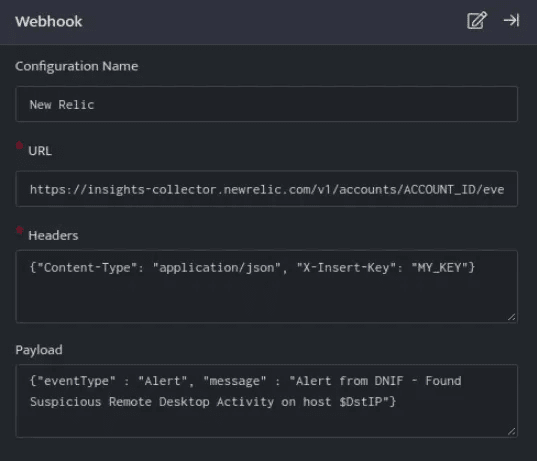
Configuration Reference
| Field | Value |
|---|---|
| Request Method | POST |
| URL (US accounts) | https://insights-collector.newrelic.com/v1/accounts/YOUR_ACCOUNT_ID/events |
| URL (EU accounts) | https://insights-collector.eu01.nr-data.net/v1/accounts/YOUR_ACCOUNT_ID/events |
| Header: Api-Key | YOUR_LICENSE_KEY |
| Header: Content-Type | application/json |
| Note: API Key TypeThe Api-Key header must use a License key from your New Relic account.Browser, Mobile, and User key types will not work and will return a 403 error.To find your License key: log in to New Relic → click your account name (top right) → API keys.Replace YOUR_ACCOUNT_ID with your numeric New Relic Account ID. |
Below is an example of how you can leverage this integration to create an event on New Relic.
Payload
{ "eventType": "Alert", "message": "Alert from Bloo - Found Suspicious Remote Desktop Activity on host DstIP"}New Relic creates an event on the New Relic account based on the values given in the payload.
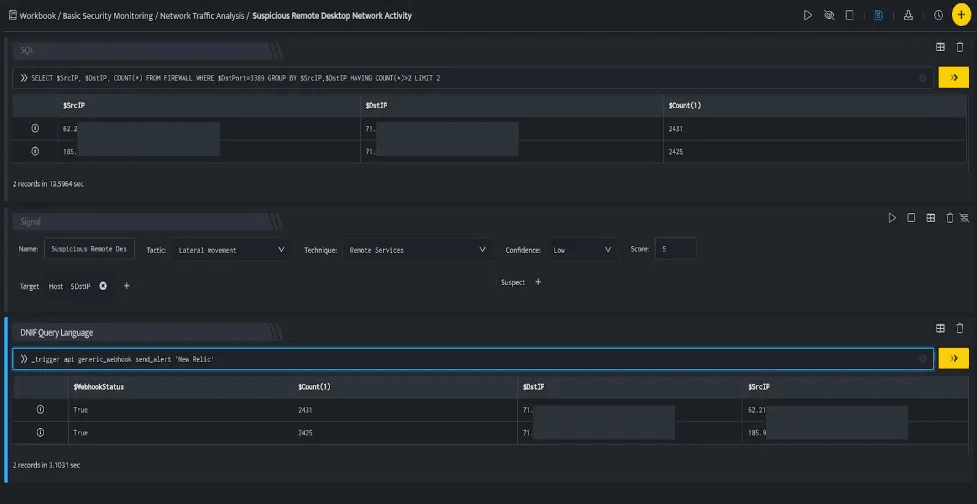
In the above figure, a workbook named Suspicious Remote Desktop Network Activity is executed which contains the following blocks:
- SQL Block: Displays two suspicious Destination IPs on execution of the workbook.
- Signal Block: This will raise a signal on detecting the suspicious IPs.
- DQL Block with _trigger query: Using Webhook integration for New Relic, an event will be created on New Relic based on the values given in the payload.
3. Related Links
Related
Was this page helpful?